
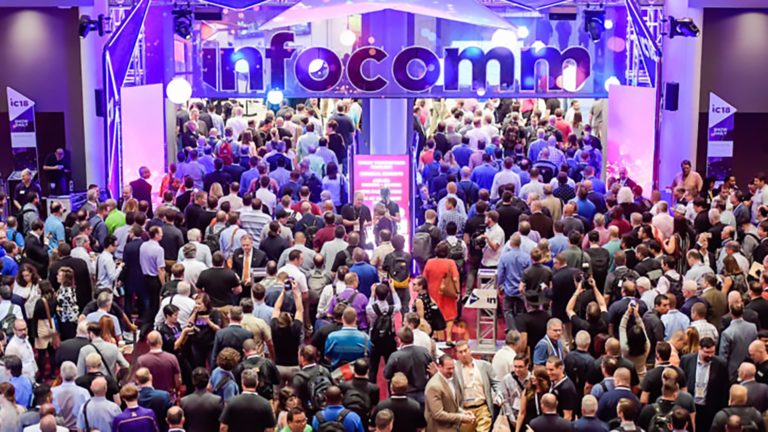
Show Recap
InfoComm 2026: The Gear That Actually Changes How We Produce Shows
Every June, the pro AV world descends on the Las Vegas Convention Center for InfoComm, and this year our team walked the floor looking for one thing: technology that makes our live productions sharper, faster, and more reliable for the artists and clients we work with. InfoComm 2026 didn’t disappoint. Between an all-in-one production box that fits in a backpack, a spray-paint-controlled LED wall, two switchers built for very different scales of show, and a stage timer smart enough to run the show alongside you, this year’s floor gave us a clear read on where live production and LED are headed.
Here’s what stood out, straight from the booths, and why it matters if you’re planning an event that needs to look and run flawlessly.
Magewell Director Plus: A Production Studio That Fits in One Case
An award-winning all-in-one switcher, streamer, and recorder from Magewell
Magewell’s newest release, Director Plus, is the third generation of their Director line and the first to handle full 4K production. What impressed us most is how much a single box now handles: multi-input switching, a graphics engine, streaming, recording, monitoring, and instant replay, all in one portable unit.
On the input side, it accepts four HDMI sources, two USB webcams, and up to ten IP streams, including NDI High Bandwidth, NDI HX, SRT, RTMP, and even a live feed from a phone through Magewell’s companion app. Add in file-based media and live web pages, and you can bring in six 4K sources or as many as sixteen HD sources into a single production. For sports and corporate work, the built-in graphics engine adds scoreboards, clocks, and four channels of instant replay, plus a telestration tool for drawing directly on screen, whether that’s breaking down a play or highlighting a slide during a keynote.
It streams to all the major platforms, outputs to HDMI for big-screen display, and runs on WiFi or a built-in 5G modem, with support for NPF batteries so it can operate fully untethered in the field. The companion app doubles as a remote control, meaning a two- or three-person crew can split duties, one person on audio, one on graphics, one on switching, all feeding the same box. It’s a serious option for anything from a solo content creator to a full corporate production team.
Graffiti+ Interactive LED Wall: Digital Art You Can Take Home
A tracked, gesture-based graffiti experience built for LED walls
Graffiti+ turns an LED wall into a digital canvas. Guests pick up a tracked spray can and paint directly onto the wall in real time, with full 3D tracking of the can’s motion. The system lets you swap colors, choose different cap styles like a “fat cap” for broad coverage, and even drop in stencils to build on. It’s tactile, immediate, and genuinely fun to watch people discover in real time.
The standout feature for us: at the end of a session, guests scan a QR code and take their creation home on their phone. That’s the kind of interactive touch that turns an LED wall from a backdrop into an actual activation, something we’re always looking for when a client wants their event to generate content people share long after they leave.
PixelHue U5 Mini: A Full Controller That Fits in Your Palm
Announced and unveiled live at InfoComm 2026
PixelHue used InfoComm to launch the U5 Mini, the newest and smallest member of their U5 controller family alongside the existing U5 and U5 Pro. Despite the size, it keeps the physical controls that make hands-on operation faster than a mouse and keyboard, T-bar, faders, and dedicated buttons for precise, tactile control, and it can pull in and control signal from the larger U5 and U5 Pro units.
It runs on USB-C or a battery pack for fully portable operation, and it’s built to control multiple switchers at once. For a VJ or operator who needs precise, physical control without hauling a full-size control surface, this is exactly the kind of compact hardware that earns a permanent spot in the road case.
PixelHue S16: A Live Streaming Switcher Built for Big Shows
Sixteen 4K inputs and serious keying power in one system
On the other end of the scale from the U5 Mini is PixelHue’s S16, a live streaming switcher with sixteen 4K inputs across HDMI or 12G-SDI. It supports two independently configurable output resolutions plus twelve independent 4K auxiliary outputs, giving large productions the flexibility to send different feeds to different screens without compromise.
Its keying setup is built for polish: a full upstream key plus two downstream keys, with scaling, borders, shadows, and DSK control, alongside a super source, two media players, and three internal sources. It also handles PTZ camera control over ONVIF or VISCA-over-IP, and can stream and record up to four channels of RTMP simultaneously, with a UVC output that lets you capture directly into OBS for local streaming. For events that need broadcast-grade switching with room to scale, the S16 is a serious contender.
CueTime: A Stage Timer That Doubles as an Assistant Show Director
The world’s first stage timer with a built-in confidence monitor
CueTime brings something we haven’t seen before: a stage timer and confidence monitor built into a single enclosure, controlled by a proprietary app. The hardware line covers a range of show sizes, from the Elite (available in 43″ and 55″) down to the Elite M and Elite LP, plus the Pro series in 24″ and 16.5″ timer-only displays. Every unit is touchscreen, supports PoE and WiFi hotspot connectivity, and receives over-the-air updates so it’s always running the latest software.
The build is clearly designed by people who’ve dealt with cable management on-site: a built-in patch panel with SDI and HDMI in and out, PowerCON and IEC power, and a PowerCON output for daisy-chaining multiple units, all recessed and slightly elevated so cables route cleanly underneath with nothing left to trip on. The ecosystem runs on Android and iOS across virtually any device, mobile, tablet, laptop, or desktop, and the app lets you pre-populate an entire show script and send one-way messages straight to the stage, like a simple reminder to speak closer to the mic.
The feature with the most long-term potential is On Cue, an assistant show director function that walks a build-in list of pre-programmed cues so that virtually anyone can call a show with confidence. CueTime also has OSC integration on its roadmap, which would let it trigger QLab, Resolume, and lighting consoles directly, pointing toward a future where timing, visuals, and show calling run off one connected system.
What This Means for Your Next Event
The throughline from InfoComm 2026 is clear: production gear is getting smaller, more flexible, and more interactive, without giving up broadcast-level quality. Whether it’s an all-in-one production box that lets a two-person crew run a full show, an LED wall that turns guests into artists, switchers that scale from a single VJ booth to a sixteen-input broadcast setup, or a stage timer smart enough to help call the show itself, the tools are catching up to what live events actually demand.
At WYWCA, this is exactly the kind of technology we’re always evaluating, not for its own sake, but for what it means for the shows, activations, and experiences we build for our clients. If you’re planning an event and want to talk through what’s possible with LED walls, live production, or interactive activations, reach out to our team.